From Dealership Floor to Factory Floor: How Hyundai and Automakers Are Commercializing Advanced Robotics
Imagine visiting a local automotive dealership to purchase a vehicle and walking past commercial humanoid units and quadrupedal utility robots displayed alongside consumer sedans and SUVs. That scenario represents the long-term vision articulated by Hyundai Motor Group Chief Executive Officer José Muñoz during the company’s recent investor presentation. By leveraging its established global network of vehicle dealerships and its internal financial services unit, Hyundai is aiming to solve one of the most persistent hurdles facing the robotics industry: the distribution and capital financing of high-cost autonomous machines.
The strategy underlines a broader transformation across the global automotive sector. Car manufacturers are no longer looking at robotics purely as specialized automated equipment for welding or painting vehicles. Instead, major automakers are evolving into primary developers, testbeds, and commercial distributors for general-purpose humanoid and specialized mobility robots. This dual role—as both heavy industrial users and commercial distributors—could fundamentally shift how advanced automation is integrated into factories, logistics centers, and eventual retail markets.
Hyundai’s Boston Dynamics Strategy and Mass Manufacturing Targets
Hyundai’s foundation in the robotics sector was cemented in 2021 when the company acquired an 80 percent controlling interest in Boston Dynamics, valuing the pioneering robotics firm at $1.1 billion. While Boston Dynamics had long been recognized for technological breakthroughs, commercializing its platforms at a global scale remained an open challenge. Hyundai’s industrial manufacturing infrastructure provides the scaling mechanism the robotics developer previously lacked.
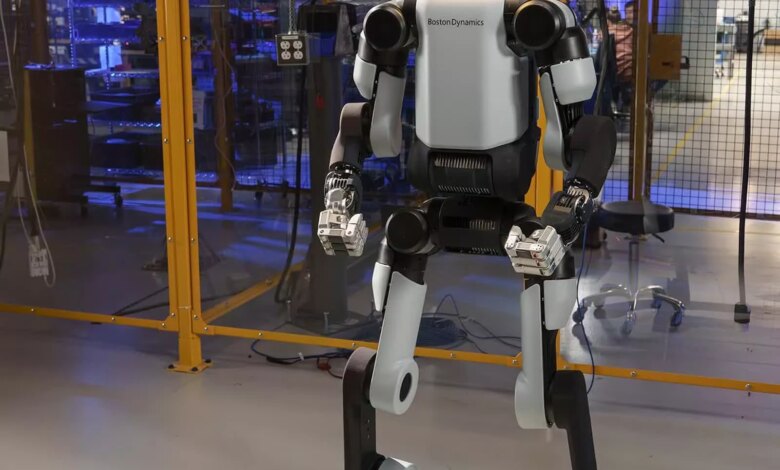
To move from specialized production to volume manufacturing, Hyundai has outlined plans to construct a dedicated manufacturing facility capable of producing up to 30,000 Atlas humanoid robots per year by 2028. The operational rollout is designed to begin internally. Hyundai intends to deploy the Atlas humanoid units at its EV manufacturing site in Georgia starting in 2028, serving as a proving ground before expanding the technology across its global manufacturing footprint.
Alongside the humanoid Atlas, Boston Dynamics’ product portfolio includes platforms tailored for immediate industrial and maintenance tasks:
- Spot: A versatile quadrupedal robot deployed across multiple sectors for facility inspection, maintenance monitoring, hazardous site observation, and trial package delivery.
- Stretch: A mobile warehouse platform equipped with a robotic arm designed specifically for high-volume tasks such as unloading freight containers and moving cargo.
- Atlas: An advanced humanoid platform built for complex, dynamic manipulation and navigation in environments originally designed for human workers.
The Economics of Commercialization: Financing High-Cost Hardware
A primary bottleneck in deploying advanced robotics is capital outlay. Quadrupedal platforms like Spot historically carried base prices starting near $74,500, with specialized industrial and research configurations pushing costs considerably higher. Enterprise humanoid platforms represent an even larger financial commitment, placing them out of reach for many medium-sized commercial operations if required as an upfront capital expenditure.
Hyundai’s proposal to utilize Hyundai Capital—its established vehicle financing division—addresses this financial barrier directly. By structuring robot acquisitions through leasing, installment financing, or hardware-as-a-service models, the automaker can lower the barrier to entry for prospective enterprise customers. Utilizing automotive dealership infrastructure for maintenance, regional delivery, and sales representation creates a built-in commercial backbone that traditional software or hardware startups cannot easily replicate.
The practical significance of this model lies in shifting advanced robotics from a specialized technology purchase to a structured operational expense. Whether aimed initially at corporate clients needing fleet automation or eventually expanded toward broader commercial markets, combining financing solutions with nationwide dealer networks establishes a concrete framework for hardware distribution at scale.
Automakers as Proving Grounds for Industrial Humanoids
Hyundai is not operating in isolation. Automotive assembly lines represent some of the most capital-intensive, highly structured manufacturing environments in the world, making them natural environments for testing general-purpose robots alongside human workforces. Several major vehicle manufacturers have initiated trial deployments with different robotics developers to test operational feasibility.
Tesla is actively refitting portions of its Fremont, California manufacturing facility to build its Optimus humanoid robot. The company plans to integrate Optimus units into its own production processes before offering the platform to commercial customers. Similarly, European automakers have integrated third-party humanoid systems directly into active production lines.
During a ten-month pilot program at its Spartanburg, South Carolina assembly plant, BMW deployed Figure 02 humanoid robots to assist in manufacturing processes, supporting the production of more than 30,000 BMW X3 vehicles. Meanwhile, Mercedes-Benz has partnered with Apptronik to test its Apollo humanoid platform inside factory environments, evaluating how multi-purpose robots can perform physical tasks alongside plant personnel.
| Automaker / Firm | Robotic Platform | Primary Operational Setting | Deployment / Target Strategy |
|---|---|---|---|
| Hyundai | Boston Dynamics (Atlas, Spot, Stretch) | Vehicle assembly, maintenance, logistics | 30,000 Atlas units/year target by 2028; Georgia facility deployment |
| Tesla | Optimus | In-house manufacturing facilities | Internal factory deployment prior to commercial sales |
| BMW | Figure 02 | Vehicle assembly (South Carolina plant) | Completed 10-month pilot supporting >30,000 X3 vehicles |
| Mercedes-Benz | Apptronik (Apollo) | Component handling and factory logistics | Operational pilot testing for plant integration |
| Logistics Partners (DHL, Maersk, Amazon) | Stretch, Agility Robotics (Digit) | Supply chain, container unloading, sorting | Active commercial truck unloading and warehouse sorting pilots |
Warehouses and Logistics: The Front Line of Adoption
While humanoid systems in vehicle assembly capture significant attention, warehouse and logistics environments currently offer the most immediate commercial viability for general-purpose automation. Repetitive, physically demanding tasks such as trailer unloading, palletizing, and container moving present clear operational targets.
Boston Dynamics’ Stretch robot is already actively operating within supply chains for major global logistics operations, including DHL and Maersk, focusing specifically on autonomous truck unloading. In parallel, logistics giant GXO and e-commerce leader Amazon have conducted operational trials using Agility Robotics’ Digit humanoid platform to handle repetitive container movements and material transfer.
These environments highlight why the early commercialization of robotics is concentrating on material handling. Warehouses feature relatively predictable layouts and clearly defined workflows, allowing autonomous systems to demonstrate measurable efficiency gains without requiring the high-speed precision necessary for complex industrial assembly.
Workforce Implications and Operational Realities
The rapid acceleration of commercial robotics raises significant questions regarding labor force dynamics. Industry representatives frequently emphasize that automated systems are intended to address labor shortages, eliminate ergonomic hazards, and take over repetitive or high-risk tasks rather than displace workers. However, the economic reality of deploying autonomous hardware creates undeniable pressure on traditional labor structures.
Robotic platforms offer operational capabilities that contrast sharply with human labor costs. Systems capable of operating extended shifts without requiring shift breaks, paid leave, or healthcare benefits represent an appealing alternative for enterprises managing tight operating margins and labor volatility. For logistics providers and industrial manufacturers, the decision to integrate robots is ultimately driven by total cost of ownership, operational uptime, and error reduction.
As Hyundai and its competitors work toward mass production, key operational questions remain. The long-term reliability of general-purpose humanoids in continuous industrial settings, the maintenance overhead associated with complex mechanical joint systems, and the overall return on investment for small and medium enterprises remain to be fully proven at commercial scale.
What is clear is that the transition from experimental prototype to commercial product is accelerating. By combining mass production goals, dealership distribution infrastructure, and dedicated capital financing, Hyundai is attempting to build the commercial framework necessary to make general-purpose robotics a standard component of industrial and commercial operations.