The Hidden Hazards of DIY Restoration: Why Professional Remediation Is Vital After Severe Property Damage
When unexpected events such as water leaks, indoor mold proliferation, structure fires, or severe atmospheric storms strike a property, building owners face urgent decisions regarding recovery. The immediate impulse for many property owners is to undertake cleanup efforts independently to minimize upfront expenses. However, physical structure remediation involves far more technical complexity than basic surface cleaning or cosmetic debris removal. Unseen moisture retention, concealed structural deterioration, and hazardous environmental contamination frequently linger long after visible damage has been cleared. Failing to thoroughly address these underlying factors can set off a chain reaction of ongoing property degradation, compromised indoor environmental quality, and mounting financial liability.
Uncovering Hidden Moisture and Structural Degradation
A primary challenge in addressing property loss is that the most destructive elements are rarely confined to exposed surfaces. Water intrudes naturally along low-resistance pathways, migrating deep behind drywall, beneath subflooring, and inside structural timber framing. In these concealed spaces, trapped moisture creates optimal conditions for continuous material decay and fungal growth long after surface water has been mopped away.
Professional remediation teams employ advanced diagnostic devices, such as moisture meters and specialized detection tools, to map the precise boundaries of moisture migration. Rather than assuming a wall cavity or subfloor is dry based on visual appearance or surface touch, technicians evaluate internal saturation levels. The practical significance of this diagnostic precision lies in preventing latent damage. When underlying saturation is identified and targeted early in the recovery process, building owners avoid the necessity of invasive structural tear-outs months down the road. Detecting sub-surface moisture immediately shifts property management from reactive damage control to systematic asset preservation.
The Technical Advantage: Industrial Equipment versus Household Tools
A major distinction between self-directed cleanup and professional restoration lies in the capability of the physical equipment deployed. Standard consumer vacuums, residential box fans, and household dehumidifiers lack the volumetric capacity needed to extract deeply embedded saturation or process high volumes of contaminated air.
Professional restoration operations rely on specialized, heavy-duty machinery designed specifically for rapid environmental remediation:
- Industrial-grade dehumidifiers engineered to pull large volumes of moisture out of dense structural materials.
- High-velocity air movers designed to maintain constant, directed airflow across damp surfaces to accelerate evaporation.
- Calibrated moisture meters that provide objective data on structural drying progress.
- Advanced air filtration systems that capture airborne contaminants and improve indoor air quality during cleanup.
Without access to industrial technology, drying cycles extend significantly. Prolonged drying timelines allow moisture to penetrate deeper into building materials, heightening the risk of structural weakening and airborne fungal distribution. The operational capability of specialized machinery ensures that moisture levels are returned to safe baselines before permanent damage takes root.
Addressing Environmental Hazards and Workplace Safety
Damaged buildings present serious safety and health hazards that extend beyond physical clutter. Water-logged environments foster rapid mold contamination, while fire incidents leave behind hazardous chemical soot, toxic ash, and corrosive residues. Furthermore, compromised properties frequently harbor structural instability and severe electrical hazards caused by water contact with electrical wiring.
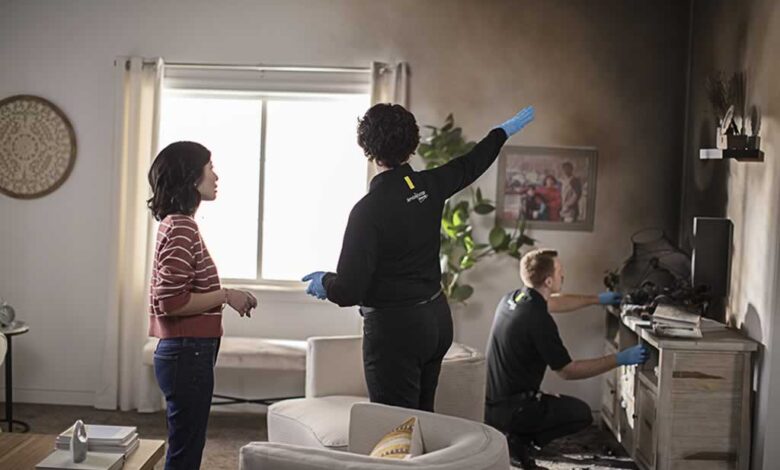
Restoration specialists, such as trained teams operating in Asheville, North Carolina, understand how to navigate these high-risk environments through rigorous containment and safety protocols. Technicians utilize specialized personal protective equipment and follow established procedures to mitigate risks. For property owners, attempting DIY cleanup without proper protective gear and containment measures risks spreading mold spores or toxic particulates throughout uninjured areas of the building. Entrusting remediation to trained professionals ensures that dangerous contaminants are safely managed and contained, prioritizing human safety throughout the restoration cycle.
Operational Efficiency and Time Reduction for Occupants
Managing property recovery independently is often an exhaustive, time-consuming process. Property owners balancing work or family obligations routinely underestimate the total labor hours required to properly inspect, dry, sanitize, and restore affected spaces. Delays at any stage of the process prolong property displacement and exacerbate operational disruption.
Professional remediation organizations operate using structured, multi-phase workflows. From initial damage assessment and structural stabilization to thorough drying and final decontamination, experienced teams execute tasks efficiently using dedicated personnel. This systematic approach drastically reduces overall project timelines. For commercial enterprises, faster completion minimizes business interruption and lost revenue. For homeowners, accelerated restoration minimizes daily life disruptions and returns occupants to a safe, functional environment far quicker than fragmented DIY attempts would allow.
Comparative Overview: DIY Cleanup versus Professional Remediation
To understand why professional intervention provides superior long-term outcomes, it is useful to evaluate how self-directed cleanup compares to professional remediation across core operational areas.
| Feature / Parameter | DIY Cleanup Approach | Professional Remediation |
|---|---|---|
| Scope of Damage Detection | Surface-level visual inspection | Advanced detection of hidden moisture behind walls and floors |
| Equipment Capability | Household fans and standard tools | Industrial dehumidifiers, air movers, and filtration systems |
| Hazard Management | Basic handling with risk of exposure | Trained safety protocols, containment, and protective gear |
| Process Efficiency | Extended timelines and potential delays | Structured, multi-stage workflows for rapid recovery |
| Long-Term Outcome | High risk of recurring moisture or mold | Root-cause elimination and preventative protection |
Long-Term Value Protection and Future Problem Prevention
The ultimate value of professional remediation lies in long-term property protection. Superficial fixes that leave residual moisture or unaddressed contamination set the stage for recurring structural decay and chronic mold issues. Over time, unresolved damage weakens structural components, damages internal finishes, and erodes overall property market value.
Professional restoration teams focus not merely on resolving immediate cosmetic issues, but on eliminating underlying root causes and implementing preventative solutions. By ensuring that structural components are thoroughly dried, cleaned, and remediated, professional service protects the property from secondary failure. Investing in comprehensive restoration at the time of the initial incident safeguards the structural integrity and financial value of the property, providing long-term confidence for property owners.