Choosing the Right Gravel for a Driveway: Balancing Durability, Aesthetics, and Drainage
Paving a residential driveway with traditional materials like poured concrete or asphalt represents a permanent, high-cost decision that often brings unexpected drainage challenges. As storm runoff management becomes a greater priority for homeowners, aggregate driveways have emerged as a practical alternative. Gravel driveways are significantly less expensive to install and offer inherent permeability, allowing rainwater to filter naturally into the ground rather than pooling on the surface or overwhelming municipal storm drains.
However, selecting the appropriate aggregate is not simply a matter of picking a pleasing color. Gravel materials vary dramatically in performance based on stone geometry, size distribution, and mineral composition. Choosing the wrong aggregate can result in a surface that shifts constantly under vehicle tires, creates deep ruts, tracks dusty debris into the home, or clogs and fails to drain properly. Understanding how different types of stone interact under pressure is essential for creating a long-lasting, functional surface.
The Structural Science: Crushed Stone vs. Naturally Formed Gravel
The primary performance factor in any aggregate surface lies in the distinction between crushed stone and naturally weathered gravel. This structural difference governs how the individual stones behave when subjected to the weight of passenger vehicles.
Crushed stone is produced mechanically by fracturing larger rock formations. This manufacturing process produces jagged, angular edges, flat faces, and irregular dimensions. When placed under pressure, these sharp, interlocking angles wedge tightly against one another. This mechanical lock creates a dense, stable matrix that resists displacement when heavy vehicle tires turn across the surface. Crushed materials are exceptionally durable and stay in place, making them ideal for heavy traffic areas. However, traditional crushed stone often features a uniform gray appearance that some homeowners consider overly utilitarian.
Naturally formed gravel, such as pea gravel and river rock, is shaped through millions of years of water flow and natural erosion. This process rounds off sharp corners, producing smooth, rounded stones. While these rounded shapes offer strong visual appeal with rich earth tones, they lack the interlocking mechanics of crushed aggregate. Under vehicle tires, smooth stones act much like tiny ball bearings, rolling against one another and pushing outward toward the edges of the driveway. As a result, natural gravel surfaces require careful management, strong side containment, and specific sizing to maintain stability.
Comparing Common Driveway Aggregate Materials
Selecting the proper aggregate requires evaluating the trade-offs between structural firmness, water movement, aesthetic appeal, and material cost. The table below compares common aggregate options suitable for residential driveways based on their structural characteristics and practical considerations.
| Material Option | Stone Type | Typical Particle Size | Key Benefit | Operational Limitation |
|---|---|---|---|---|
| Decomposed Granite | Natural (Weathered Granite) | 3/8 inch down to fine dust | Compacts into a firm, highly stable walking and driving surface | Reduced permeability compared to coarse gravel; fine dust can stick to shoes |
| All-Purpose Gravel Mix | Natural Aggregate Mix | 3/8 inch | Smooth texture; balances easy walking with efficient water drainage | Small particle size requires perimeter containment to prevent lateral displacement |
| Marble Chips | Crushed Marble | 2 to 4 inches | High aesthetic value with bright, light-reflective white and gray tones | Higher material cost; requires substantial base support |
| Sized Pea Gravel | Natural River Stone | 1/2 to 1-1/2 inches | Larger profile interlocks better than fine pea gravel while maintaining soft earth tones | May require binder additives or sand matrix to minimize rolling under heavy vehicles |
| Small River Pebbles | Natural River Stone | 1 to 3 inches | Delivers premium landscape aesthetics and excellent void-space drainage | Higher price point; creates a less uniform, rockier walking surface |
In-Depth Material Selection and Performance Characteristics
Evaluating specific material types helps clarify how individual aggregates perform over time in real-world driveway applications.
Decomposed Granite (DG): Created through the natural weathering of solid granite, this material consists of extremely fine stone fragments mixed with microscopic silt and sand particles. When spread and rolled, decomposed granite locks together tightly, forming a smooth, compact surface that rivals hard paving in terms of foot and vehicle stability. However, because the space between particles is minimal, water moves through it slowly compared to coarse stone. In heavy downpours, compacted DG can experience surface washouts if slope angles are not managed properly, and the fine dust can transfer onto footwear and vehicle tires.
Small All-Purpose Gravel: Blends of small, smooth natural stone measuring roughly 3/8 inch offer a versatile middle ground. The varied shapes allow the aggregate to pack down reasonably well, establishing a stable path for tires while preserving generous void spaces between stones. These open spaces allow rainwater to pass instantly through to the subsoil. Because small smooth stones can still migrate over time, pairing this material with installed edging is highly recommended.
Crushed Marble Chips: Crushed architectural stone options like marble chips serve homeowners seeking a sophisticated aesthetic. Measuring between 2 and 4 inches, these angular chips provide excellent structural resistance against vehicle displacement. The large individual stones do not shift easily, and the angular cuts lock the surface into place. The trade-off is primarily financial, as decorative stone carries a higher price tag than regional crushed granite or limestone.
Larger Pea Gravel Formulations: While traditional small pea gravel (1/4 inch or less) shifts too easily for main vehicle pathways, larger pea gravel selections ranging from 1/2 inch to 1-1/2 inches offer a practical solution. The larger mass of these stones makes them less prone to being kicked out by vehicle tires. Mixing a modest amount of sand into large pea gravel can fill interior voids just enough to bind the stones together without destroying the surface’s overall permeability.
Sized River Pebbles: standard river rock is generally unusable for driveways because large, rounded stones roll excessively under wheel loads. However, river pebbles processed specifically into the 1-to-3-inch range offer a workable alternative for aesthetic driveways. Their multi-tonal, naturally polished surfaces enhance curb appeal while maintaining sufficient drainage pathways. Because the surface remains somewhat uneven, river pebbles are best suited for low-speed residential driveways and decorative parking turnouts.
Engineering and Layered Installation
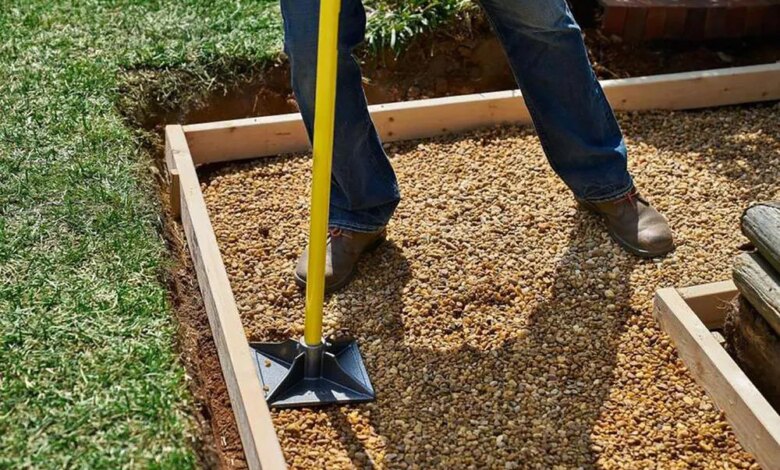
The long-term performance of any gravel driveway depends largely on the hidden base structure beneath the top layer of stone. Pouring aggregate directly onto raw topsoil inevitably leads to driveway failure, as heavy vehicles push the gravel down into the soft earth, resulting in rutting, mud intrusion, and structural sinking.
A resilient driveway relies on a engineered, multi-layer foundation:
- Sub-Base Layer: The foundational layer requires 6 inches of large, coarse, angular stone (typically 3 to 4 inches in diameter). This layer creates a rigid, structural framework that distributes heavy vehicle loads across a wider area of subsoil while keeping ground moisture from rising.
- Intermediate Layer: Placed directly over the sub-base, this layer consists of 2 to 3 inches of smaller crushed aggregate (typically 3/4 inch to 1-1/2 inches). This fill layer bridges the wide gaps between the large sub-base rocks, preventing the finer top dressing from sifting downward over time.
- Surface Wearing Layer: The visible top layer consists of 2 inches of chosen driveway gravel, decomposed granite, or decorative stone. Keeping the top layer around 2 inches prevents vehicles from creating deep tire tracks or feeling unstable underfoot.
Calculating the correct amount of material is straightforward. A standard residential driveway requires a target aggregate coverage depth of approximately 4 inches across its surface layers. Because 4 inches equals one-third of a foot, calculating material needs requires multiplying the driveway length by its width in feet to find total square footage, then dividing that figure by 3 to arrive at the required volume in cubic feet.
Preventing Displacement and Managing Long-Term Maintenance
Maintaining a functional gravel surface requires proactive steps to manage stone displacement, weed growth, and water movement.
Installing a high-quality geotextile weed barrier between the native soil base and the lowest stone layer creates a permanent physical barrier. This membrane prevents persistent weeds from pushing up through the aggregate while keeping subsoil mud from mixing into the clean stone foundation. For existing weed growth on mature gravel surfaces, non-chemical interventions like concentrated vinegar sprays or targeted propane torch weeding provide effective management without contaminating surrounding groundwater.
To eliminate lateral displacement—where vehicle tires push loose aggregate onto adjacent lawns or gardens—homeowners should install continuous perimeter borders. Rigid landscape edging made of heavy-duty plastic, metal strips, timber, or set masonry blocks effectively traps loose gravel within the intended drive path. In high-traffic turning zones, installing honeycomb-style gravel stabilizer grids beneath the top surface locks small stones inside individual cellular pockets, yielding a surface as firm as asphalt while remaining fully permeable.
Finally, routine maintenance should include periodic hand raking to redistribute displaced aggregate, clear organic debris like fallen leaves, and keep the drive path smooth. Over time, as surface aggregate gradually breaks down under normal use, applying a light fresh top dressing every few years restores original depth and keeps the driveway functioning reliably for decades.